Hybrid Plans

Introduction

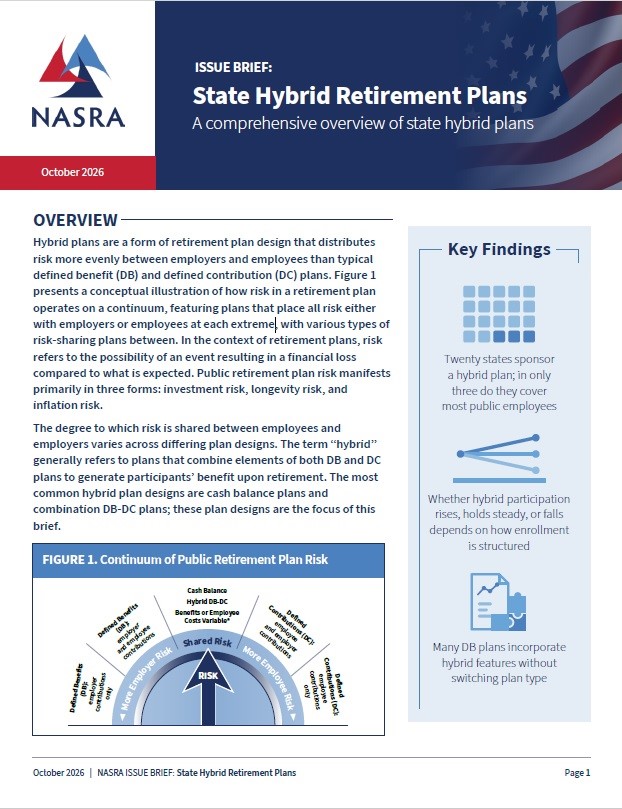
Hybrid plans are a form of retirement plan design that distributes risk more evenly between employers and employees than typical defined benefit (DB) and defined contribution (DC) plans. Figure 1 presents a conceptual illustration of how risk in a retirement plan operates on a continuum, featuring plans that place all risk either with employers or employees at each extreme, with various types of risk-sharing plans between. In the context of retirement plans, risk refers to the possibility of an event resulting in a financial loss compared to what is expected. Public retirement plan risk manifests primarily in three forms: investment risk, longevity risk, and inflation risk.

The degree to which risk is shared between employees and employers varies across differing plan designs. The term “hybrid” generally refers to plans that combine elements of both DB and DC plans to generate participants’ benefit upon retirement. The most common hybrid plan designs are cash balance plans and combination DB-DC plans; these plan designs are the focus of this brief.


Date published

October 2026

Contact

Alex Brown, Research Director

Download Issue Brief


Become A Member

Becoming a member of NASRA offers a unique opportunity to join a community committed to the sound, efficient, and innovative stewardship of public retirement systems. Membership connects you with a network of professionals and experts, providing valuable insights into managing public retirement systems with a focus on sustainability and risk-averse strategies.

By joining NASRA, you gain the tools and resources to enhance the management of public retirement systems, ensuring their long-term success and reliability for generations to come.

What’s New at NASRA: Employee Contributions to Public Pension Plans

Employee contributions remain a central part of public pension financing, and the way those contributions are structured is subject to change depending each states' governance rules. . NASRA’s 2026 updated brief finds median employee contribution rates of 6.2 percent of pay for employees who participate in Social Security and 9.0 percent for those who do not. For employees who do not participate in Social Security, the public pension often plays a broader role in retirement security, effectively providing two of the traditional three legs of the retirement stool rather than one.

Since 2009, 41 states  increased employee contributions in at least one plan, while some states recently reduced rates for selected employees. Variable contributions are also becoming more common, with 26 plans in 17 states adjusting employee rates based on funding, plan costs, or other factors. The brief provides current trends and a state-by-state look at employee contribution requirements across public retirement systems.